Designing Professional Gas Log Books with a Versatile KDP Interior Template
In industries where fuel consumption, safety compliance, and equipment maintenance are tightly linked, the humble log book remains an indispensable tool. Whether you manage a fleet of commercial vehicles, operate a restaurant kitchen with gas appliances, or oversee residential heating systems, consistent record-keeping is non-negotiable. The Gas Log Book KDP Interior Template offers a streamlined pathway for publishers, entrepreneurs, and safety managers to create customized, print-ready record journals on Amazon KDP, all without advanced design skills.
What Defines a Functional Gas Log Book?
Before diving into the template's specifications, it's helpful to understand the core components of an effective gas log book. These aren't simply blank notebooks; they're structured instruments that transform scattered observations into actionable data. Common pages might track usage volume, pressure readings, visual inspection results, repair dates, or operator signatures. An intelligently designed interior anticipates these recurring fields, providing dedicated spaces for unit identification, meter readings, timestamps, anomaly notes, and compliance checklists. The Gas Log Book KDP Interior Template embodies this foresight, delivering layouts that balance openness with essential guidance.
Consider the example of a delivery company documenting daily propane cylinder exchanges. Without a systematic log, discrepancies in inventory, missed leak checks, or faulty regulators can go unnoticed until they cause downtime or safety hazards. A well-structured book prompts the user to record cylinder serial numbers, connection integrity, and quantity dispensed, creating an audit trail. The template's preformatted sections reduce the cognitive load, making it easier for staff to maintain thorough records even during busy shifts.
How the Template Accelerates the Self-Publishing Workflow
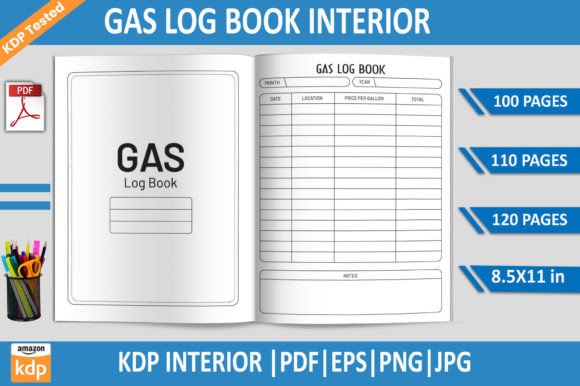
For KDP publishers, the leap from concept to uploaded interior often involves navigating page dimensions, bleed settings, and font consistency. This template bundle removes guesswork by delivering a Gas log book KDP interior Template that has been rigorously tested on Amazon’s platform. Rather than starting from a blank canvas, you receive ready-to-use files that already adhere to the critical 8.5x11 inch trim size and 300 DPI resolution requirements. This means you can focus on customization—adding a brand logo, adjusting titles, or tweaking column labels—while the underlying structure remains KDP-compliant.
The inclusion of multiple page-count variants (100, 110, and 120 pages) is a thoughtful detail. Different applications demand different capacities. A quarterly inspection log for a small clinic might need 100 pages, whereas an annual vehicle fuel tracker could benefit from 120 pages to accommodate weekly entries. Having these options allows you to market distinct SKUs or let customers choose the format that matches their recording frequency. The files open seamlessly in Adobe Illustrator, but the EPS and transparent-background PNG assets also invite collaboration with other vector or raster editors, making the template accessible to both seasoned designers and newcomers relying on open-source alternatives.
Unpacking the File Ecosystem: More Than Just a PDF
The strength of this template lies in its multi-format delivery. Each file type serves a specific stage of production:
- PDF files (100, 110, 120 pages): The core deliverables for direct upload. They are flattened, print-formatted PDFs ready for KDP's ingestion system. Since they have been KDP tested, you can trust that fonts, margins, and alignment won't trigger automated rejection flags during the review process.
- EPS file: The editable master file. For those wanting to embed company watermarks, adjust table borders, or replace standard headers with multilingual terms, the EPS preserves the vector integrity. This is crucial when adapting the template for niche audiences—say, changing “Gas Type” to “LPG / Natural Gas” with a dropdown visual cue.
- PNG and JPG files: These support marketing and hybrid workflows. A transparent-background PNG of a page spread can be layered over a mockup to showcase the interior on a promotional image. High-resolution JPGs can be imported into Canva or other browser-based editors for quick social media teasers. The combined assets empower you to build a cohesive brand presence around the log book product.
Notably, the No Bleed specification simplifies inner page formatting. Full-bleed images aren't necessary for most log book interiors, and removing this requirement means you won't need to account for trim variance on every page. The 8.5x11 inch size is generous enough for comfortable handwriting, while staying within standard printer and binder dimensions if someone chooses to print at home even after purchasing the paperback version on Amazon.
Real-World Use Cases That Demand a Professional Interior
The applications stretch far beyond the obvious fuel logs. Here are several scenarios where the Gas Log Book KDP Interior Template provides tangible value:
1. Industrial Kitchen Compliance
Restaurants rely on gas for ranges, griddles, and fryers. Health inspectors and fire marshals often require documented proof of daily equipment checks: pilot lights, gas shut-off valve function, ventilation hood operation. A dedicated log book with pre-labeled fields for station location, inspector initials, and time of check converts a five-minute routine into a defensible record. The template’s clean typography ensures no confusion between different appliance zones.
2. Medical Gas Cylinder Inventory
Hospitals and dental clinics maintain storage rooms of oxygen, nitrous oxide, and other medical gases. Tracking cylinder levels, expiration dates, and manifold pressure readings is a patient-safety imperative. Using a customized version of the template, a facility manager can create a log that includes cylinder color codes, regulator status, and operator training verification. The resulting document becomes part of the facility’s accreditation evidence folder.
3. Construction Site Equipment Monitoring
Temporary heaters, concrete curing blankets, or cutting torches often run on propane or acetylene. Site supervisors can adapt the interior template to include weather conditions, bulk tank percentages, and safety briefing sign-offs. The structured layout prevents disjointed notes scribbled on scrap paper, reducing the risk of overlooked leak checks after weekend shutdowns.
4. Residential Landlord Inspections
Property owners with multiple rental units can brand and publish their own annual gas safety log. Tenants or maintenance staff tick off carbon monoxide detector tests, boiler pressure readings, and flue integrity. A professionally printed book signals to tenants that the landlord takes safety seriously, while simultaneously organizing follow-up actions for any flagged issues.
Technical Specifications That Matter for Amazon KDP
Publishing on KDP demands meticulous attention to technical parameters. The Gas Log Book KDP Interior Template address these head-on. The 300 DPI resolution guarantees that text and any included line art remain crisp, even on the interior pages printed via Amazon’s POD (print-on-demand) service. Lower resolutions can introduce fuzziness, particularly for small subheadings or checkboxes. Since the files are KDP tested, publishers bypass the frustrating cycle of uploading, getting a margin error, tweaking, and re-uploading. The “tested” validation means the template adheres to the required inside margin (gutter) that accommodates perfect binding without swallowing content.
The availability of editable EPS files introduces a layer of future-proofing. If Amazon updates its print specifications—say, adjusting minimum spine margins for thicker volumes—you can globally modify the parent file and regenerate all page counts rather than manually editing each PDF. Furthermore, because the template uses common fonts placed on safe background layers, text reflow errors are minimized when switching between system environments.
Customization Pathways Without Overcomplication
New publishers often hesitate to invest in a template, worrying it will lock them into a rigid appearance. On the contrary, this bundle encourages personalization. Starting with the EPS file in Adobe Illustrator, you can recolor header bars to match a brand hex code, introduce a subtle graph-paper pattern behind the data entry grids, or insert a motivational quote at the bottom of each page in an unobtrusive gray. The transparent-background PNG elements also allow you to build a digital lookbook: combine a few interior pages with cover mockups, and you’ve got an A+ Content graphic that explains the book’s internal structure to potential buyers.
For those selling on Etsy or a standalone website in addition to KDP, the high-resolution JPGs become valuable product imagery. Show a two-page spread with realistic handwriting samples (using a placeholder font that mimics cursive) to illustrate how customers will fill in the daily columns. This visual storytelling reduces purchase hesitation because the shopper immediately grasps how the journal functions, without having to decipher a text-based description alone.
Why “Instant Download” and “Ready to Upload” Matter for Entrepreneurs
Speed to market can make or break a KDP product launch, especially in crowded niches like journals and notebooks. When you identify a trending demand—for instance, a sudden regulatory change requiring more detailed gas appliance logs—you need a responsive production pipeline. The Gas log book KDP interior Template eliminates the days you’d otherwise spend designing page bleeds, testing alignment, and converting formats. Since it’s an instant download after purchase, you can theoretically craft a brand-specific version, wrap it in a compelling cover, and submit to KDP within the same afternoon. This agility allows you to capitalize on seasonal peaks, such as pre-winter safety campaigns or post-holiday equipment audits.
Equally important is the risk mitigation provided by the “100 tested” assurance. Amazon’s content review process can be opaque; an interior file that met guidelines a year ago might now trigger a “low-resolution interior” warning if the platform’s automated checker has been updated. Knowing that the base file already passed multiple uploads provides peace of mind, especially for publishers managing dozens of low-content titles simultaneously.
Best Practices for Leveraging the Template Effectively
To maximize the value of this asset, consider these implementation strategies:
- Map your reader’s journey first. Identify whether your target audience is a professional needing instant reference or a personal user wanting simplicity. This will guide how many instructional headings you insert, because a single page of usage tips at the beginning can transform a bare-bones log into a user-friendly tool.
- Maintain consistent page navigation. If you include a year-at-a-glance calendar or quick-reference section, use the existing template master as a structural anchor. Don't disturb the underlying margin guides, because they’re calibrated for the binding edge.
- Test print before publication. Even with KDP-tested files, order a physical proof. Check that handwriting space feels generous enough, that the contrast between printed lines and the paper stock is comfortable for prolonged use, and that the book lies flat when opened.
- Bundle the interior with supplementary resources. Consider creating a digital companion (QR code inside the book) that links to a sample filled page or a video tutorial on common gas safety protocols. This enriches the customer experience without altering the template’s structure.
- Optimize your KDP listing with exact terminology. In your book description, use phrases like “8.5x11 gas usage tracker,” “pre-printed log sheets for safety checks,” and “no-bleed interior template for KDP” to align with what customers are searching for.
Addressing Common Misconceptions About KDP Interiors
A frequent hesitation is that a “template” implies a generic, low-quality outcome. In practice, the opposite happens when you strategically overlay your insight. The Gas Log Book KDP Interior Template gives you a professionally typeset skeleton; your knowledge of what a specific industry needs—like fields for “odorant test completed” in a natural gas log—turns a blank page into a specialized instrument. Another misconception is that PDF files are immutable. While the uploaded PDF for KDP shouldn’t be edited post-submission, the source EPS file is fully adjustable, and the PNG/JPG assets support rapid prototyping of new page styles before committing to a final vector revision.
Finally, there’s the assumption that only massive publishers benefit from no-bleed, high-DPI interiors. Consider the independent safety consultant who writes a brief guide and wants to include a logbook section at the back—using this template as a modular insert, they can prototype a professional appendix in minutes. The barrier to entry lowers considerably.
Expanding Your Product Line Beyond a Single Gas Log
Once you’ve successfully published a gas log book, the template’s adaptability invites adjacency. The same page structure, with minor label modifications, can become a water meter log, an electrical panel inspection journal, or a chemical inventory tracker. The presence of the EPS file means you can fork your product line without starting from scratch each time. Pairing these offshoots with consistent cover design builds a recognizable brand on Amazon, where customers often return to buy the “next edition” from a trusted seller. Additionally, you can cater to corporate bulk orders by offering a custom-branded white-label version—tables remain identical, but the header gets the client’s logo. The speed of this fulfillment would be impossible without a proven, editable base interior.
The Gas Log Book KDP Interior Template thus functions not just as a single product asset, but as a launchpad for a series of practical record-keeping tools. Its blend of technical compliance, multi-page options, and editability aligns with both the creative freedom publishers crave and the stringent requirements of the KDP ecosystem.