Is a KDP Low Content Book Planner Worth Adding to Your Publishing Toolkit?
Publishing low-content books on Amazon KDP can seem deceptively simple. After all, a notebook or a logbook does not require a sprawling manuscript. The challenge lies elsewhere—in the invisible scaffolding of niche selection, keyword strategy, metadata optimization, and iterative refinement. A KDP Low Content Book Planner steps into this gap, offering a structured way to organize the often chaotic behind-the-scenes work. Whether it genuinely accelerates your workflow depends on how you currently manage your process and what you expect from a planning tool.
What Exactly Is a KDP Low Content Book Planner?
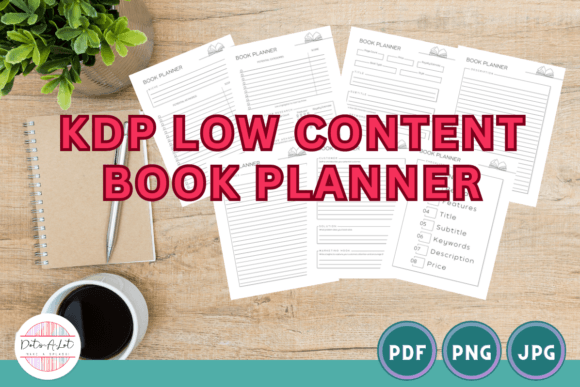
At its core, a KDP Low Content Book Planner is a curated set of worksheets or digital templates designed to guide you through the pre-publication stages of a low-content book. Unlike generic business planners, it is built specifically for the Amazon Kindle Direct Publishing ecosystem. A typical package includes dedicated sheets for brainstorming niches, tracking keyword research, mapping out interior page designs, categorizing books for optimal visibility, and logging completed projects. The version highlighted here comes as a package of seven minimalist sheets, delivered in PDF, PNG, and JPEG formats. This means it can function equally well as a printable physical planner or as a digital file you annotate with a stylus and tablet app.
The promise is straightforward: reduce the mental clutter that comes from juggling spreadsheets, scratch notes, and browser bookmarks. By centralizing your planning, you theoretically free up more energy for creative and strategic thinking.
Why Publishers Consider a Dedicated Low-Content Planner
Anyone who has launched even a handful of low-content books understands that the process fragments quickly. You might keep a running list of seasonal niches in a phone note, dump keyword phrases into a spreadsheet, and sketch cover ideas on loose paper. Over time, this scattered system becomes a bottleneck. A dedicated planner appeals to publishers who feel that disorganization is slowing their output or leading to missed opportunities.
Several practical motivations often surface:
- Niche saturation demands sharper research. The early days of uploading generic lined journals and seeing steady sales are mostly gone. Today, standing out requires a methodical approach to niche selection, which a planner can enforce.
- Keyword hunting is multi-layered. Effective keywords bridge the gap between what customers type into the search bar and what your book listing shows. A planner sheet dedicated to keyword tracking can help you log seed terms, long-tail variations, and competitor insights in one place.
- Consistency across a portfolio matters. If you aim to build a recognizable brand across multiple interior types—say, gratitude journals, puzzle books, and trackers—a planner can help you maintain thematic and formatting consistency.
- Categorization affects royalties and visibility. Amazon's category system is not always intuitive. A structured approach to selecting and validating categories can help avoid miscategorization, which directly influences discoverability.
Evaluating the Benefits Beyond the Obvious
On the surface, a planner saves time by eliminating the need to recreate templates for each new project. However, the more meaningful benefits are often behavioral. A physical or annotated digital planner forces a pause between the impulse to publish and the act of uploading. That reflective gap can be the difference between a book that sinks into obscurity and one that aligns with genuine demand.
Consider the following practical advantages:
- Pre-launch diligence becomes a habit. When you fill out the same category evaluation sheet for every project, you are less likely to cut corners or skip market validation.
- Keyword records create a reusable asset. Over multiple launches, your filled planner becomes a personal database. You can mine past keyword sheets for new angles, seasonal pivots, or underperforming niches worth revisiting.
- File format flexibility reduces friction. The availability of PDF, PNG, and JPEG formats means you can print copies for a tactile desk workflow, import the PDF into a digital annotation tool like GoodNotes or Notability, or even load JPEGs into design software if you want to customize the sheets further.
Tradeoffs and Candid Considerations
No tool is universally perfect, and a KDP Low Content Book Planner comes with compromises worth examining before committing your time or money.
Learning curve versus immediate utility. Even a minimalist seven-sheet planner requires an initial setup effort. If you already maintain a crisp, well-organized digital system in Notion, Airtable, or a spreadsheet stack, you may find the planner duplicates rather than replaces your existing structure. The real question is whether the specific layout and prompts surface insights your current system misses.
Static structure versus evolving needs. A planner, by design, freezes a workflow into a particular sequence. If your publishing process changes—for example, you pivot from journals to medium-content puzzle books that require more complex interior planning—some sections may feel constraining. Printable sheets cannot dynamically recalculate data like a spreadsheet can, and digital annotations are only as searchable as the app you use allows.
Coverage depth varies. A seven-sheet package is concise by nature. It likely covers niches, keywords, categories, a project overview, cover planning, interior layout sketches, and a launch checklist. If you need advanced features like profit margin calculators, advertising campaign trackers, or A+ Content planners, you will need supplementary tools. The planner is a starting framework, not an all-in-one business command center.
Manual effort remains. No planner conducts keyword research for you. It provides a structured place to record what you discover, but you still need to invest time using tools like Amazon's search bar, third-party keyword research software, or category browse paths. The planner amplifies the value of your research effort; it does not eliminate it.
When a KDP Low Content Book Planner Is a Strong Fit
Certain profiles align particularly well with this type of resource. You may be an ideal candidate if:
- You are newly transitioning from publishing one or two books casually to treating low-content publishing as a serious side income stream and need a repeatable process.
- You thrive with visual, tactile planning methods and find spreadsheet cells uninspiring or overwhelming.
- You prefer working with a stylus on a tablet for digital annotation and want a clean, ad-free template rather than building your own from scratch.
- You appreciate minimalist design that eliminates visual noise and allows you to focus on the content of your planning rather than formatting.
- You manage multiple niches simultaneously and struggle to keep project-specific details from bleeding into one another.
In these scenarios, the modest investment in a focused planning system often pays for itself by preventing costly mistakes—like publishing a book in a miscategorized node with unoptimized keywords—that suppress early momentum.
Situations Where Alternatives May Be Worth Considering
Conversely, a dedicated KDP Low Content Book Planner might not be the best match in every case. Consider alternatives if:
- You already operate a mature, customized project management system in Trello, ClickUp, or a spreadsheet you have refined over many launches. Migrations take energy, and a new planner format may feel disruptive rather than additive.
- You publish exclusively through automation tools or bulk upload services that bypass detailed manual planning stages. In high-volume, low-touch models, the card-swiping method of filling out individual sheets per project may slow your pipeline.
- You need deep analytical integration, such as dynamic keyword ranking tracking or sales velocity projections by niche. A static planner cannot replace data-aggregating software.
- You are a seasoned publisher whose process is already tightly calibrated. In this case, the planner may offer marginal gains at best, unless you are explicitly seeking a format change to spark fresh thinking.
A practical approach is to audit your current publishing cadence. Identify the single biggest bottleneck. Is it chaotic research? Forgetting to optimize categories? Losing track of interior design dimensions? If the bottleneck matches one of the planner's core sheets, the tool may have disproportionate value. If your bottleneck is somewhere else entirely—like advertising creative or cover design iteration—a planner focused on metadata and planning will help only peripherally.
Making the Decision That Aligns With Your Goals
Choosing to integrate a KDP Low Content Book Planner into your workflow is less about the tool itself and more about your publishing philosophy. Do you want your process to feel more deliberate, more repeatable, and less reliant on memory? A planner supports that shift, but only if you commit to using it consistently across multiple projects. A single use will not transform your business any more than a single notebook page changes your year.
Before deciding, evaluate the file format compatibility with your preferred working style. If you are anchored in a completely paperless, cloud-synced environment, confirm that your PDF annotation app of choice renders the planner sheets cleanly and allows for easy navigation. If you prefer paper, consider whether printing seven sheets per project feels sustainable or whether you will eventually abandon it for a digital alternative. The availability of PNG and JPEG formats also opens the door to embedding planner elements within larger digital workspaces like digital whiteboards or layered design files, adding flexibility that purely printable planners lack.
Ultimately, a well-designed planner reduces the friction between having an idea and executing it thoroughly. It cannot make decisions for you—it will not pick your niche or write your keywords—but it can make the path from insight to published book straighter and less cluttered. For publishers who feel their current method is holding back their output, or for newcomers who want to start with a structured backbone rather than developing one through trial and error, this type of resource can serve as a quiet, dependable part of the creative toolkit. The key is to see it as a framework for rigorous thinking, not a shortcut around the research and testing that low-content publishing demands.