The Quiet Rise of Niche Puzzle Content in a Digital-First Creative Economy
There is a noticeable shift happening across independent publishing and low-content book creation. What once felt like a fringe interest has matured into a legitimate product category, with creators and entrepreneurs building entire catalogs around themed activity books. The Flowers Wordsearch Puzzle sits precisely at this intersection of calming aesthetics and functional entertainment, representing something larger than a simple pastime. It reflects how modern content creators think about audience needs, mental wellness, and the enduring appeal of analog activities in a screen-saturated world.
This is not merely about word searches. It is about understanding what makes a product marketable, printable, and genuinely useful for an end user who might be a senior looking for cognitive stimulation, a florist seeking branded downtime activities, or a teacher integrating botanical vocabulary into a lesson plan. The format—ready for Amazon KDP, delivered as both a polished PDF and an editable PPT file—signals a mature approach to product development that solo entrepreneurs and small studios can learn from.
What Actually Defines a Flowers Wordsearch Puzzle Product
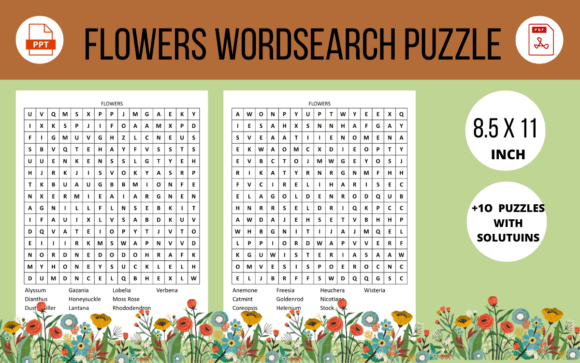
At its core, a Flowers Wordsearch Puzzle is a curated collection of word search grids where every hidden term relates to flowers, blossoms, botanical names, and horticultural concepts. But framing it only as a puzzle book undersells the intentionality behind the design choices. The specific configuration—100 flower-related words distributed across puzzles, each occupying a full page at 8.5 x 11 inches, with solutions provided—tells us something about how the creator anticipated user experience. No bleed settings mean the interior pages are clean and self-contained, simplifying both digital viewing and physical printing. The 300 DPI resolution ensures that even when printed at home or through a print-on-demand service, the text remains crisp and legible, which is a non-negotiable quality signal for buyers who have been burned by blurry interiors before.
The dual file format is also worth examining. A PDF file ready for KDP upload eliminates friction for creators who want to publish quickly. Meanwhile, including a PPT file opens up possibilities that pure PDF products cannot touch—educators can modify difficulty, rearrange puzzles, or isolate specific pages for classroom handouts. This dual-purpose delivery reflects a broader trend where products serve multiple use cases without demanding additional purchases.
Why Low-Content Books Are Gaining Serious Professional Attention
For years, low-content and medium-content books like journals, planners, coloring books, and puzzle books were dismissed as low-effort cash grabs. That perception has shifted significantly. Professionals now recognize that the audience for these products is real, discerning, and growing. Buyers evaluate puzzle books based on theme coherence, legibility, solution accuracy, and whether the activity provides a genuine sense of accomplishment. A Flowers Wordsearch Puzzle that delivers 100 words across 21 pages with verified solutions meets a psychological need for completion and order that digital media often disrupts with notifications and infinite scrolling.
Market observers note that the global puzzle market continues to expand, driven partly by an aging population seeking cognitive maintenance and partly by younger demographics embracing analog hobbies as a form of digital detox. Flowers as a theme carry additional weight. Botanical imagery and language are associated with relaxation, mindfulness, and biophilic design principles that influence everything from office layouts to smartphone wallpapers. A word search centered on floral terminology quietly taps into that same biophilic impulse—it is an intellectual engagement with nature, even when the solver is sitting indoors.
The Creator Perspective: Building Products That Solve Actual Problems
Entrepreneurs and freelancers evaluating product ideas should pay attention to what makes the Flowers Wordsearch Puzzle viable beyond its thematic appeal. Several practical considerations stand out to someone familiar with the KDP ecosystem and content monetization:
- Upload readiness eliminates technical barriers. A properly formatted PDF with correct trim size, resolution, and no-bleed settings means the file passes KDP's automated checks without manual adjustments. This saves hours of troubleshooting for creators who are not graphic designers by trade.
- Page count aligns with perceived value. Twenty-one pages with solutions included feels substantial without being bloated. Customers correlate page count with value, but excessive repetition harms reviews. The balance here suggests intentional curation rather than content stretching.
- Editable source files extend the product lifecycle. The PPT file is not just a bonus—it is a strategic asset. A marketer could extract individual puzzles for social media posts, a teacher could adapt vocabulary for different grade levels, and a coach could use the format as a template for entirely new themes.
These features matter because the modern creator economy rewards products that reduce cognitive load for the buyer. When someone purchases a puzzle book, they are not just buying paper and ink. They are buying an experience that requires zero setup, delivers on its promise, and potentially teaches them something new about flowers along the way.
Connecting Puzzles to Larger Consumer and Lifestyle Trends
The Flowers Wordsearch Puzzle does not exist in isolation. It belongs to a larger movement where consumers actively seek out screen-free activities that still feel productive. This is not nostalgia for its own sake. It is a functional response to digital fatigue. People report feeling mentally drained after hours of video calls, social media scrolling, and fragmented attention. Word searches offer a gentle, self-paced cognitive challenge that contrasts sharply with the algorithmic urgency of digital platforms.
Florists, garden centers, and botanical-themed brands have also begun exploring puzzle content as low-cost promotional items or value-add products. Imagine a garden center including a floral word search in a customer's bag during a spring sale. The activity reinforces the brand's identity while giving the customer something pleasant to do at home. A Flowers Wordsearch Puzzle with a professional layout and clear solutions fits that use case perfectly because the brand does not need to design anything from scratch.
Senior care facilities, memory cafes, and occupational therapy practices represent another relevant audience. Word searches are widely used as cognitive stimulation tools, and themed content around familiar, pleasant subjects like flowers can enhance engagement among older adults. The large 8.5 x 11 inch format with one puzzle per page is particularly helpful for individuals with visual or motor challenges, as it avoids cluttered layouts that can cause frustration.
Design Decisions That Signal Professionalism
Examining the specifications of this particular product reveals thoughtful choices that separate professional-grade puzzle content from amateur efforts. The 300 DPI resolution is a technical detail that many first-time creators overlook, leading to complaints about print quality. The no-bleed setting means the puzzle content stays safely within margins, which is essential because KDP's print-on-demand process can shift trimming slightly. A creator who understands and communicates these specifications signals competence to buyers who have been disappointed by poorly formatted books in the past.
The decision to make each puzzle one page in size also deserves attention. Some puzzle books cram multiple puzzles onto a single page to inflate the total count, but this frustrates users who need space to write or who simply prefer a clean visual field. A full-page layout respects the user's experience and makes the book accessible to a wider range of ages and abilities. Combined with the 100-word vocabulary scope, the product promises enough variety to feel worthwhile without becoming repetitive.
How Niche Puzzle Content Fits Into Diversified Income Strategies
For freelancers and entrepreneurs building portfolio income, niche puzzle books represent a scalable product category with relatively low ongoing maintenance. Once a Flowers Wordsearch Puzzle is published on KDP, it can generate passive revenue for years with only occasional updates. The flower theme has the added advantage of being evergreen—flowers do not go out of style, and seasonal spikes around spring, Mother's Day, and gardening season can boost visibility without additional advertising effort.
Some creators go further by building an entire series around botanical themes: flower word searches, herb crossword puzzles, plant coloring books, and garden journaling prompts. The consistency across products strengthens brand recognition and encourages repeat purchases. A customer who enjoys the floral word search may naturally seek out another title from the same creator. This compounding effect is one reason why professionals treat low-content publishing as a serious business rather than a hobby.
Educational and Cognitive Value Beyond Entertainment
It would be a mistake to categorize a Flowers Wordsearch Puzzle solely as entertainment. Word searches build pattern recognition, reinforce spelling, and expand vocabulary in ways that feel effortless to the user. When the vocabulary is thematic rather than random, the learning effect intensifies. A puzzle featuring "rhododendron," "chrysanthemum," "echinacea," and "wisteria" subtly teaches botanical terminology. Over time, solvers internalize these words, which can enrich their appreciation of gardens, floral arrangements, and nature writing.
Teachers and homeschooling parents have long recognized the value of themed word searches as supplementary learning tools. A unit on plant biology, pollination, or springtime ecology can incorporate a floral word search as a low-stakes activity that reinforces key terms. The provided solutions mean that students can self-check, which supports independent learning. The fact that the product includes an editable PPT file extends this educational utility, allowing instructors to adapt content for different reading levels or to focus on specific vocabulary subsets.
What Buyers Actually Evaluate Before Purchasing
Understanding buyer psychology is essential for anyone creating or marketing puzzle content. When a potential customer lands on a KDP listing for a Flowers Wordsearch Puzzle, they quickly assess several factors:
- Does the cover clearly communicate the flower theme and word search format?
- Are interior previews available, and do they show legible grids with adequate spacing?
- Does the product description confirm that solutions are included?
- What do reviews say about puzzle quality, error rates, and print clarity?
Professionals who understand these evaluation criteria design their products to address each point proactively. Including solutions removes a common objection. Using high-resolution formatting prevents negative reviews about blurry text. Selecting a universally appealing theme like flowers broadens the addressable market without diluting the product's identity. These are not secrets—they are observable patterns in successful low-content listings that aspiring creators can study and apply.
The Intersection of Creativity and Commercial Viability
There is sometimes a tension between creative expression and commercial pragmatism in product development. The Flowers Wordsearch Puzzle demonstrates that these two forces can coexist. The creative expression shows up in word selection, puzzle arrangement, and the subtle pleasure of a well-designed page. The commercial pragmatism appears in the KDP-ready formatting, the multi-format delivery, and the awareness of what the market will pay for. Creators who navigate this balance effectively build sustainable businesses that do not require them to compromise their standards or chase fleeting trends.
For those observing the space from a marketing or trend-analysis perspective, products like this signal a maturation of the creator economy. We have moved past the era where anyone with a hastily assembled interior could publish and profit. Today's buyers are more discriminating, and the algorithms that surface products reward quality signals. A puzzle book with verified solutions, professional formatting, and a cohesive theme is far more likely to generate positive reviews and organic visibility than a generic, error-ridden alternative.
Practical Takeaways for Creators and Marketers
What can someone learn from examining a well-executed Flowers Wordsearch Puzzle? Several actionable insights emerge for professionals working in adjacent spaces:
- Theme selection matters more than novelty. Flowers are familiar, universally positive, and searchable. Chasing obscure themes can limit discoverability, while a well-worn theme executed with care often outperforms novelty.
- Multi-format delivery increases perceived value and real utility. A PPT file adds no significant production cost but dramatically expands the product's use cases. This principle applies broadly—consider what editable or supplementary formats might enhance your own offerings.
- Technical specifications are part of the product experience. 300 DPI, correct trim size, no-bleed settings—these are not just production details. They directly affect whether the end user can read, write on, and enjoy the product. Ignoring them leads to returns and negative reviews.
- Solutions are not optional. For puzzle products, including solutions is a baseline expectation. Failing to provide them signals incompleteness and disrespects the customer's time.
These lessons extend beyond puzzle books. Any digital product, printable, or KDP publication benefits from the same disciplined attention to user experience, formatting integrity, and multi-format accessibility.
Looking Ahead Without Speculating
The demand for analog activities in a digital world shows no sign of reversing. As screens become more pervasive, the counterbalancing appeal of paper-based puzzles, journals, and activity books strengthens. Flowers as a subject carry timeless associations with beauty, growth, and tranquility—qualities that people actively seek in their leisure time. A product that combines these elements into a cohesive, professionally formatted package is well-positioned to serve a market that values both substance and simplicity.
The Flowers Wordsearch Puzzle may appear modest at first glance, but it embodies principles that matter across the creative economy: understand your user, respect their experience, deliver on your promises, and make your product genuinely useful in more than one context. Those principles will remain relevant regardless of how platforms, algorithms, or trends evolve.